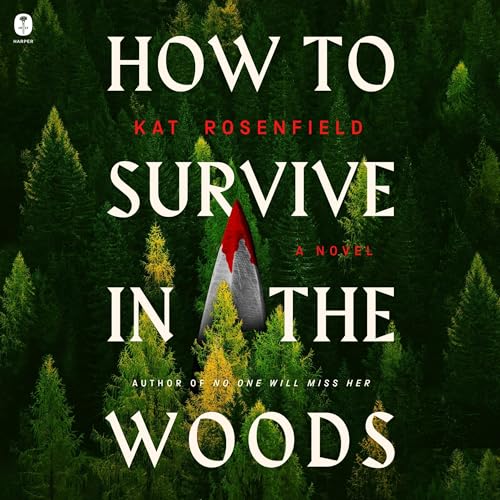
Raised by a doomsday prepper and hardened by the startup world, Emma Sharp has learned how to endure—especially in her marriage to Logan Grant, a charismatic tyrant who keeps her under tight control. To Emma, her marriage is a cage: it keeps you in, but it also keeps you safe. Until it doesn’t.
When Emma forms an unexpected bond with Logan’s former girlfriend, the two women form a plan to help Emma take her life back. Destination: the punishing final stretch of the Appalachian Trail known as the Hundred Mile Wilderness.
After all, bad things happen in the woods all the time.
As the three venture deeper into Maine’s backcountry, desire and dread curdle into something unpredictable, dark, and deadly. Someone is lying. Someone is watching. And in the remote heart of the forest, someone is about to be lost . . . or found.
This is a difficult one to rate, and you’ll understand why in my review—and you’ll likely see a wide range of ratings on Bookstagram. It’s a twisty psychological thriller with a HEAVY focus on character psychology, especially the FMC. If you’re expecting a fast-paced popcorn thriller, it’s not that—it’s a layered story with an emotionally fractured protagonist and has compelling themes of trauma, memory, control, queer relationships, and family trauma.
Emma Sharp, raised in a strict survivalist past & trapped in a controlling marriage with Logan, agrees to hike a dangerous wilderness trail with him and his former partner Taylor. The isolated trek quickly unravels buried secrets, shifting loyalties, and hidden motives, putting survival at risk.
The story is told in a 3rd-person POV focused so much on Emma that it almost feels uncomfortable and claustrophobic, like you’re trapped in her head. She’s a classic unreliable narrator, and her emotional instability and fractured memory make her version of events constantly questionable. Her relationship with Logan, who quickly becomes her husband, begins in an unsettling way, immediately marked by control. Emma’s backstory is slowly revealed through lots of flashbacks—from her childhood complicated relationship with her father (who shaped a lot of her present behavior) to fragmented memories with Mara, her first love, which are equally disturbing.
Once Emma, Logan, and Taylor—who share a complicated love triangle—are in the woods together, the dynamic becomes increasingly menacing, and you can feel an impending sense of betrayal. Be prepared to suspend your disbelief for scenes that feel like fever dreams, where it becomes difficult to tell whether what’s happening is real or only happening in Emma’s unstable mind.
The book really had the potential to be a five-star read—and for some readers it will be—but pacing is problematic. While the present-day storyline is very gripping, it’s so frequently interrupted by flashbacks and long stretches of introspection focused on Emma’s past and mental state that it’s difficult to remain fully engaged. The book is 320 pages, but because of its heavy psychological content and nonlinear structure, it feels longer—and the present-day plot arguably makes up less than half of the book. Fortunately, the story builds towards a thrilling climactic ending with several twists that will satisfy even seasoned thriller readers. When all is said and done, there’s a sense of unease that lingers!
Overall, this is a highly original psychological thriller that will work best for readers who enjoy unreliable narrators, fragmented storytelling, and slow-building psychological tension. If that sounds like your kind of read, it’s definitely worth picking up—you might come away really loving it!!
Narrator Performance
The audiobook of How to Survive in the Woods is narrated by award-winning narrator Sophie Amoss, renowned for her work in character-driven thrillers.
Amoss portrays protagonist Emma with an anxious voice layered with vulnerability that perfectly captures an unreliable narrator shaped by trauma. For antagonist Logan, Amoss uses a controlled, restrained voice that at times sounds menacing, which works well for a controlling character who seems to be hiding his true intentions. The other central character, Taylor, who’s in a love triangle with Emma and Logan, is portrayed with a calmer, more inviting voice, almost too much at times, that makes you question her true nature.
Even with the book’s nonlinear structure—constantly moving between present day, flashbacks, and Emma’s internal dialogue—Amoss adjusts her pacing and tone to make each shift clear and easy to follow, so listeners are never confused—the true sign of a seasoned performer! A real highlight of the performance is how she builds atmospheric tension. As Emma, Logan, and Taylor enter the woods, there’s a creeping sense of dread that really comes through. The dialogue between the three characters is always engaging and intense—Amoss adds pauses and subtle vocal nuances when characters are speaking to make it hard to fully trust anyone.
Overall, the narration elevates the story and brings the characters, even secondary ones like Emma’s father and her first love, Mara, to life with distinct, recognizable voices that make the audiobook feel more like a movie in your mind. If you’re considering this book, the audiobook is a great format, but it’s worth listening at a slightly slower speed due to the nonlinear structure and psychological depth that Amoss handles so well!
Narrator Performance
The audiobook of How to Survive in the Woods is narrated by award-winning narrator Sophie Amoss, renowned for her work in character-driven thrillers.
Amoss portrays protagonist Emma with an anxious voice layered with vulnerability that perfectly captures an unreliable narrator shaped by trauma. For antagonist Logan, Amoss uses a controlled, restrained voice that at times sounds menacing, which works well for a controlling character who seems to be hiding his true intentions. The other central character, Taylor, who’s in a love triangle with Emma and Logan, is portrayed with a calmer, more inviting voice, almost too much at times, that makes you question her true nature.
Even with the book’s nonlinear structure—constantly moving between present day, flashbacks, and Emma’s internal dialogue—Amoss adjusts her pacing and tone to make each shift clear and easy to follow, so listeners are never confused—the true sign of a seasoned performer! A real highlight of the performance is how she builds atmospheric tension. As Emma, Logan, and Taylor enter the woods, there’s a creeping sense of dread that really comes through. The dialogue between the three characters is always engaging and intense—Amoss adds pauses and subtle vocal nuances when characters are speaking to make it hard to fully trust anyone.
Overall, the narration elevates the story and brings the characters, even secondary ones like Emma’s father and her first love, Mara, to life with distinct, recognizable voices that make the audiobook feel more like a movie in your mind. If you’re considering this book, the audiobook is a great format, but it’s worth listening at a slightly slower speed due to the nonlinear structure and psychological depth that Amoss handles so well!
The audiobook of How to Survive in the Woods is narrated by award-winning narrator Sophie Amoss, renowned for her work in character-driven thrillers.
Amoss portrays protagonist Emma with an anxious voice layered with vulnerability that perfectly captures an unreliable narrator shaped by trauma. For antagonist Logan, Amoss uses a controlled, restrained voice that at times sounds menacing, which works well for a controlling character who seems to be hiding his true intentions. The other central character, Taylor, who’s in a love triangle with Emma and Logan, is portrayed with a calmer, more inviting voice, almost too much at times, that makes you question her true nature.
Even with the book’s nonlinear structure—constantly moving between present day, flashbacks, and Emma’s internal dialogue—Amoss adjusts her pacing and tone to make each shift clear and easy to follow, so listeners are never confused—the true sign of a seasoned performer! A real highlight of the performance is how she builds atmospheric tension. As Emma, Logan, and Taylor enter the woods, there’s a creeping sense of dread that really comes through. The dialogue between the three characters is always engaging and intense—Amoss adds pauses and subtle vocal nuances when characters are speaking to make it hard to fully trust anyone.
Overall, the narration elevates the story and brings the characters, even secondary ones like Emma’s father and her first love, Mara, to life with distinct, recognizable voices that make the audiobook feel more like a movie in your mind. If you’re considering this book, the audiobook is a great format, but it’s worth listening at a slightly slower speed due to the nonlinear structure and psychological depth that Amoss handles so well!