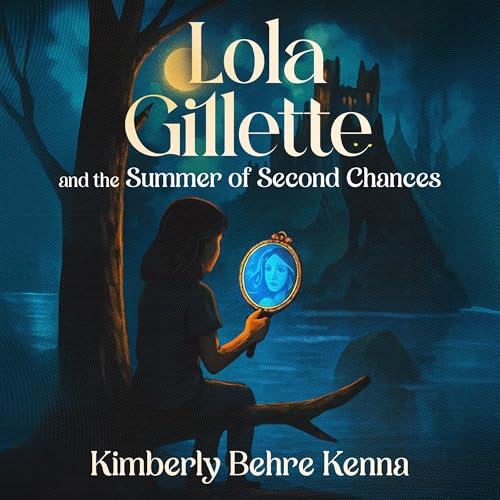
Thirteen-year-old Lola is determined to honor her perfect twin sister, who died in an accident Lola can’t forgive herself for. To make things right, she’s on a mission to complete their Perfect Pairs Collection—but one mistake lands her in serious trouble. Now, instead of facing reform school, Lola must spend August with her eccentric, agoraphobic Uncle Milo in his crumbling mansion on the Connecticut River.
What begins as punishment quickly turns into a summer full of strange discoveries: a Zen garden gone wrong, a holographic projector spitting ghostly messages from her late aunt, a mysterious houseboat, and even a wandering wolf. As Lola races to complete her lucky baker’s dozen of perfect pairs, she starts to realize that magic isn’t about collections or luck—it’s about healing, forgiveness, and finding where she truly belongs.
Lola Gillette and the Summer of Second Chances is a heartwarming coming-of-age family drama that will draw you in from the start. Even though it’s marketed as YA, mostly because of its 13-year-old protagonist, the story’s meaningful themes make it appealing for readers ranging from middle grade to adults—especially in how it explores heavier topics like grief, guilt, mental health, and seeking redemption. The story also has subtle magical realism elements that are seamlessly woven in without ever fully crossing into fantasy territory. This is the 3rd book in the author’s Brave Girls collection of standalone novels—the first two installments were award-winning—and this one has the same level of emotional depth that will connect you to the characters and leave you reflecting on your own life long afterwards!
The story is told through thirteen-year-old Lola’s first-person POV, but her inner thoughts and emotions are so well articulated that even adults will resonate with her. She’s been holding in so much since the death of her twin, and anyone who has suppressed emotions after a loss will find her story very relatable. The backstory of how her twin sister passed away is slowly revealed over the course of the summer, and there are moments where all of Lola’s emotions come pouring out—so be sure to have tissues on hand.
On top of that, Lola is driven by her need to fix things—she thinks if she can help her uncle, save the family castle, or continue the tradition of collecting paired items for her and her sister to reach a lucky “baker’s dozen,” it might somehow balance out the wrong she thinks she’s done. Her parents, who are mostly background characters, are also dealing with grief and marital strain, and it’s clear they’ve unintentionally neglected their surviving daughter, adding further strain to Lola’s emotional well-being.
And then the story becomes even more layered—Lola’s uncle is deep in grief after losing his wife and is barely holding it together, which is reflected in the state of the castle he owns. The castle feels both haunting and magical—it’s worn down, with entire sections closed, yet it carries a sense of history, with puzzle-locked doors and hidden treasures that add to the magical realism. Add in a mystical wolf that appears at key moments and seems to guide Lola, along with the enchanting forest and lake setting, and the story is very immersive—and it really feels like you’re right there with Lola every step of the way!
Another highlight of the story is the relationship between Lola and Kaya, a girl who lives in a cottage by the beach with her father. Kaya is often the voice of reason in their interactions and an uplifting presence. Their relationship quickly grows into a sisterly bond—not as a replacement for Lola’s sister, but as someone for Lola to hold onto while she heals.
At only 170 pages (about 4 hours on audio), the story never feels rushed but still manages to pack in a lot of storytelling and character growth. As Lola experiences adventure, danger, frustration, and obstacles, you really see her growth. The story’s climax is dramatic, suspenseful, and emotional but still believable—and in the aftermath, Lola comes to realize that moving forward isn’t about fixing the past but about accepting it. The final chapters are written in a powerful, heartfelt way that lingers!
Overall, this is another strong installment in the series, and its memorable characters and universal themes will resonate with a wide range of readers. This book is especially a great option for fans of character-driven fiction focused on relationships and emotional growth, subtle magical realism, and stories about grief, healing, and starting over. If this sounds like something you’d enjoy, don’t hesitate to pick up a copy or check out the entire series!
Narrator Performance
The audiobook of Lola Gillette and the Summer of Second Chances is narrated by award-winning narrator Candace Fitzgerald. She gives Lola a youthful voice that sounds determined, tense, and introspective, accurately portraying a character who is carrying suppressed emotion and guilt over her twin’s death and is driven by a constant need to fix things. In contrast, Fitzgerald portrays Kaya, the girl who befriends Lola, with a much calmer, more uplifting tone, which really highlights her role as the grounding “voice of reason” in Lola’s life. For Uncle Milo, who is in deep grief over his wife’s death, Fitzgerald uses a worn-down, heavy voice that captures his emotional exhaustion, especially in the scenes where he withdraws or snaps at Lola, making their relationship feel strained but believable.
One of the highlights of the audiobook is the dialogue between Lola and Kaya. The narration really emphasizes their contrasting personalities and how their connection grows into something that feels like a sisterly bond. The delivery also gives the story a strong coming-of-age, summer vibe that feels cinematic.
Fitzgerald also gives a wide range of secondary characters—from Lola’s parents to Kaya’s father to members of the town—distinct enough voices to be easily recognizable and engaging, giving the audiobook an almost full-cast feel.
By the end, Fitzgerald shifts her performance of Lola to reflect her emotional growth, giving her a more self-assured, reflective tone, especially in her inner monologue and interactions with her parents. In the final chapters, Fitzgerald’s delivery really conveys that this isn’t just a story about Lola getting a second chance but about an entire family slowly beginning to heal—and it leaves you with a heartwarming, satisfied feeling at the end!
Narrator Performance
The audiobook of Lola Gillette and the Summer of Second Chances is narrated by award-winning narrator Candace Fitzgerald. She gives Lola a youthful voice that sounds determined, tense, and introspective, accurately portraying a character who is carrying suppressed emotion and guilt over her twin’s death and is driven by a constant need to fix things. In contrast, Fitzgerald portrays Kaya, the girl who befriends Lola, with a much calmer, more uplifting tone, which really highlights her role as the grounding “voice of reason” in Lola’s life. For Uncle Milo, who is in deep grief over his wife’s death, Fitzgerald uses a worn-down, heavy voice that captures his emotional exhaustion, especially in the scenes where he withdraws or snaps at Lola, making their relationship feel strained but believable.
One of the highlights of the audiobook is the dialogue between Lola and Kaya. The narration really emphasizes their contrasting personalities and how their connection grows into something that feels like a sisterly bond. The delivery also gives the story a strong coming-of-age, summer vibe that feels cinematic.
Fitzgerald also gives a wide range of secondary characters—from Lola’s parents to Kaya’s father to members of the town—distinct enough voices to be easily recognizable and engaging, giving the audiobook an almost full-cast feel.
By the end, Fitzgerald shifts her performance of Lola to reflect her emotional growth, giving her a more self-assured, reflective tone, especially in her inner monologue and interactions with her parents. In the final chapters, Fitzgerald’s delivery really conveys that this isn’t just a story about Lola getting a second chance but about an entire family slowly beginning to heal—and it leaves you with a heartwarming, satisfied feeling at the end!
The audiobook of Lola Gillette and the Summer of Second Chances is narrated by award-winning narrator Candace Fitzgerald. She gives Lola a youthful voice that sounds determined, tense, and introspective, accurately portraying a character who is carrying suppressed emotion and guilt over her twin’s death and is driven by a constant need to fix things. In contrast, Fitzgerald portrays Kaya, the girl who befriends Lola, with a much calmer, more uplifting tone, which really highlights her role as the grounding “voice of reason” in Lola’s life. For Uncle Milo, who is in deep grief over his wife’s death, Fitzgerald uses a worn-down, heavy voice that captures his emotional exhaustion, especially in the scenes where he withdraws or snaps at Lola, making their relationship feel strained but believable.
One of the highlights of the audiobook is the dialogue between Lola and Kaya. The narration really emphasizes their contrasting personalities and how their connection grows into something that feels like a sisterly bond. The delivery also gives the story a strong coming-of-age, summer vibe that feels cinematic.
Fitzgerald also gives a wide range of secondary characters—from Lola’s parents to Kaya’s father to members of the town—distinct enough voices to be easily recognizable and engaging, giving the audiobook an almost full-cast feel.
By the end, Fitzgerald shifts her performance of Lola to reflect her emotional growth, giving her a more self-assured, reflective tone, especially in her inner monologue and interactions with her parents. In the final chapters, Fitzgerald’s delivery really conveys that this isn’t just a story about Lola getting a second chance but about an entire family slowly beginning to heal—and it leaves you with a heartwarming, satisfied feeling at the end!